Ten Second Exercise

A homily for the fourth Sunday in Ordinary Time


Hello, faithful. My sister is an R.N., and every now and then, she’ll suggest some things to me. Like she says, she will introduce me to probiotics. Boy were those good. And she said the probably the best over-the-counter thing you can take is magnesium. It’ll help you sleep. Boy, is that good. Her third suggestion was a ten second body exercise.


Just 10s, she said. Hold one foot up off the floor for 10s, then hold the other foot off the floor for 10s. So it’s the 20 second exercise, and she says it’ll do wonders. It helps your balance, helps your stride, and it even helps your memory. Like I oftentimes say, I have a 35 second memory. People say, who’s like this was at table last night. Who’s the director of our seminary in El Salvador? And I said, I don’t know, but I’ll know in 35 seconds because the memory takes that long sometimes to pop in. And she says this exercise will shorten that. So all it is, is you pick up one foot and hold it in the air for 10s. It helps the brain, helps the balance, helps the stride, helps the posture.


10s. And so I can do that. So 12345678.


I’m trying I’m trying. Well, this I think is going on in today’s gospel. It’s an exercise we’re beginning the great sermon on the Mount. Jesus is great sermon. And I think it’s all about just transformation into a new creation. And it starts with the Beatitudes and the Beatitudes, I think are almost like when you read, you know, in a textbook, the introduction.


By the end of this chapter, the students should be able to. And that’s the Beatitudes. By the end of this chapter, by the end of the students, sermon on the Mount, the students should be able to live poverty. Spirit should be a peacemaker, should be merciful, should be compassionate, should be tolerant of persecution. This is the end result.


It’s not the beginning. The Beatitudes introduces what this sermon will do. And it’s like, if you can do these ten seconds, you will be greatly improved. If you can do this exercise, this spiritual exercise of trying to be merciful or trying to be compassionate or trying to be a peacemaker, just a little thing to, turn the other cheek or, walk the other way, or reach out in compassion or be generous or just a little bit. It will grow. You’ll be able to hold one foot off the ground for five minutes. I suspect if you did it every day, it’s the same with these, these and these ideas in the sermon on the Mount. We do them every day, just a little bit. We will grow to be great spiritual beings. Like this. Exercise is for one’s physical self.


The Beatitudes is for one’s spiritual self. Saint Teresa writes, we ought to thank the Lord who makes us desirous of pleasing him, even though our works be weak. Of course the works be weak, but if we do them every day, they get stronger and stronger and stronger. If I can hold one foot up off the ground for 10s a day, my brain will get stronger and stronger and stronger.


I think there’s a great parallel here. So we ought to thank the Lord who makes us desirous of pleasing him, even though our works be weak.

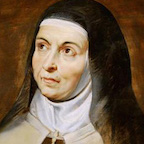
Saint Teresa of Avila

Riffing on the Name

A homily for the third Sunday in Ordinary Time


For the feast of Saint Gregory the Great, which is in September. The passage from Office of Readings, part of the Breviary, part of the liturgy of the hours, is really good. It’s something written by Saint Gregory, and he’s riffing on his name, Gregory, which means watchful. And he says he’s far from watchful. He’s busy in the monastery, he’s a Benedictine, and he finds himself gossiping all of a sudden and gossiping mean.


Or when he’s pope, he’s expecting, you know, the best food, the best. And he says, it’s just he finds he’s not watchful at all, and he’s got to be more watchful. That’s why he takes the name servant of the servants instead of Lord of Lords or anything. I think that same kind of riffing on the name is what’s happening in today’s gospel.


We have Jesus along the shores of the sea of Galilee, and he sees Simon and Andrew and says, come, follow me, and I will make you fishers of men. We think it’s just follow him and you’ll be evangelizing. But I think he’s riffing on the name Andrew. Andrew, like the word androgynous or, And it means just the man.


And so when he says, I will make you fishers of men, he’s actually saying, I will make you fishers of the man. He’s saying, I’m going to make you fishers of yourself. If you follow me, you’re going to catch yourself. You’re going to learn yourself. You’re going to be fully yourself. And I think Saint Teresa of Avila says this very well.


Jesus comes to her and she says, what’s the point of prayer? And he says, you will find yourself in me and you will find me in yourself. It’s just like journey. The more we know ourselves, we journey into ourselves. The more we learn Jesus, but the more we learn Jesus and His law and his ways and his commands and his gospel, the more we learn of ourselves.


It’s like a spiral of more. Find yourself in me. Find me in yourself. Find yourself in me. Find me in yourself. Higher and higher. We can think of it as closer and closer. Find yourself in me. Find me in yourself. Find yourself in me. Find yourself me in yourself. Till you’re one. You’re so close. That’s the mystical marriage.


So I think that’s what Jesus is offering. Simon and Andrew and James and John before they can become fishers of humanity. They’ve got to be fishers of themselves.

Saint Teresa of Avila

6 7

A homily for the Baptism of Jesus


At Halloween time, I carved a pumpkin into a jack o lantern and I texted that out to my friends, including Ryan, newly ordained guy, and he texted back him in his Halloween costume. And it was a jacket, like a hoodie. That’s at six seven and he has a stole on and he’s carrying, oils in his hands, and he says he is doing the anointing of the sick seven.


So I texted back, I don’t know what that means. I texted back, I’m a bit lost in the imagery. Just give each a scapular and that will get them into heaven. Playing off the anointing thing. He texted back. Six seven is a meme. Popular among the teens. So it’s a play on words and theological sacramental allusion of anointing of the sick seven, because the sacrament is called anointing of the sick. So six seven and the meme is like, you just do this and six and you say, six, seven. What does it mean? I don’t think anybody knows what it means. I bring this up as we’re celebrating the baptism of Jesus. What does it mean? Because oftentimes we think baptism is the washing away of sin.


Jesus is sinless. Why would he do that? But baptism is more. It all comes from Saint Paul’s letter to the Romans. Saint Paul, after the soul saw incident, is baptized, but he isn’t told what it means, so he thinks about it. Well, last time he was all wet. He was getting clean. So maybe it’s the washing away. Not of dirt of sin.


The first time he was all wet and people looked at him. He was being born. So he says, well, it could be like being born again. And then he’s, you know, he’s a seafarer or that’s why he’s traveling around the Mediterranean in a boat. Could it be like burial? Burial at sea. Just drop the body in a baptism because they bury the baptized by immersion.


And so it was like being buried. And then you come out again. Resurrection could be like that. And he says, every time I enter a building, I wash my feet and hands. It was the custom made. So maybe it’s just entering a building. The building of the church. So he has a lot of ideas. What baptism means. What is it?


Which is it? I think it’s all of them. So six. Seven. We don’t know what it means. It means anything to anybody. But it’s a powerful meme for youngsters. Especially because it means they belong. They’re the in-group. They are there. I think that ultimately is what baptism means. We belong. We’re here. We’re. We are the in-group. Maybe that’s why Jesus chose to be baptized.


To be part of us. With us. Journeying with us. I don’t know what Jesus would do with six seven, but I think he loves baptism. Saint Teresa of Avila says, in this house, all are friends, all are loved, all are helped, all are held dear. And that’s what baptism does, It brings us into that house. And that’s what we celebrate today.

Saint Teresa of the Avila

Why, oh Why

A homily for the Fourth Sunday in Advent


A darling in the motivational speaker circuit is a guy named Simon Sinek. And his thing is tell me why. Why does your company do what it do. Not what does it do? Why does it do? Because what is not inspiring. What we do isn’t that inspiring. But why we do it inspires people, enthuses people. Gets people to sign on board.


That’s much more important is the why do you understand your why? In today’s gospel, I think we see this. Joseph has gotten the news. Mary is pregnant, they’re engaged and it has to be broken by a divorce. In those days, engagement was strong. But she’s pregnant. And the what, the law says divorce her. And probably everybody in town is saying divorce her and the law is saying stone her.


Her and everybody in town is probably saying stone. Her. That’s the what the what is the law, the what is what people are saying. But Joseph digs in deeper the why. This angel comes to him in the dream and says, Take Mary. I think what is heart was coming. This dream was just what his heart was already telling him.


You love this woman. Do the act of love. Why? Because you love her. And I think that’s the call of today’s gospel is not to do what we do because we do it. Why do we do it? Find out the why. Oftentimes, like in a parish mission statement, a parish mission statement will tell you what the parish does, but not why it does it.


Teresa of Avila has a great quotation, I think. Very good for Christmas time. And she writes, “know that you too are a child of God. So allow your soul the freedom to sing, dance, praise and love”. Oh, that’s a great why. Not a what, it’s a why. Because we’re a child of God. We’re going to dance and sing.


That’s not a what. That is a profound why. So I’m this as we approaches, as we approach Christmas. Ask yourself, why do I do what I do? Dig deep and it will change your Christmas and change your life.

Saint Teresa of Avila

To Build a Tower, Build a Tower

A homily for the 23rd Sunday of Ordinary Time


When I was a seminarian they constantly talked about the spirituality of priesthood and the spirituality of priesthood. Yeah, spirituality is like Christian spirituality. Human spirituality. There is no spirituality, no priesthood. Until I was ordained as a priest. Then, wow. There is a spirituality of priesthood. And I found it was because every day I had to ponder the scriptures.


What am I going to say that day? Preach that day. Every day I celebrate the sacraments and sacraments. Are these powerful like deep, intuitive of ceremonies that have lots of power. And so it was powerful spirituality. And I said, it’s based on the practice to do the spirituality. Priesthood means to do the work of priest. And the more you do the work of priest, the deeper the spirituality.


And I extended that then to other other vocations like the vocation of marriage. I think the spirituality of marriage is doing the work of being married, saying, I love you. Let’s dialog about this. I forgive you just to kiss the person just to day by day, just like pure spirituality. The priesthood is everyday practice. Being a priest every day.


Practice being a spouse and it will change you. And so that’s what I think Jesus is getting at with his. You have to to be his follower. You have to turn your back on brother, sister, house mother, you know, etc. etc. it’s because these things can keep us from the practice of being good, holy Christians, good, holy people, good, holy transform from human beings to humane beings, transformed to being Christian beings.


And then the second part of today’s gospel is about what, builder would build and then run out of materials, or what army came, would go against that army that’s superior. I will extend his metaphors to say you learn by doing. You learn how to build towers, by building towers, you learn how to be a soldier by being a soldier.


And I think you learn how to be human by being human. And you learn how to be Christian by being Christian. I think that’s the bottom line of today’s gospel is day by day, be mindful and determined to be a priest, or to be a spouse, or to be a Christian, and that will change you deeply.

Saint Teresa of Avila

Getting the Last Word

A homily for the 22nd Sunday in Ordinary Time


I was on a seminary board and one of the members said, we’re not in compliance. And I said, what does that mean? And he says, canon law says we should have one novitiate with one novice master, and we have one division with two novice masters, one from the New York province, one from the Chicago province. That’s not in compliance.


And so I thought for a while, you know, what we could say is we really have like two divisions, said one for New York Province, one for Chicago Province in the same building, we’ll call it co-institutional. And he looked at me and said, that’s so stupid. I hate being called stupid. I got, man. But I said, well, let’s refer it to Rome.


Let’s see what Rome says. And he says, okay, all right. So he wrote, because he’s afraid I would leave the letter. Rome wrote back like three months later and said, you can consider it constitutional. A New York province and its Chicago Province division in the same building. I was right, and so, of course, could I be a gracious winner?


No, not at all. I’d have the last word. So I said, hey, I’m right. Rome. You know how the Latin goes. Rome, Roma lucuta set, causa finita est Rome has spoken. The cause is done. And the guy said, Rome is wrong and you’re wrong. So there and so, I guess no cause of beneath us. No. You’re wrong. Then it became union.


Yes yes yes yes. No no no. It was ugly and stupid. Each of us had to have the last word. But silly. Well, today the gospel is about when you go to a wedding, take the least seat. That way, if you’re your bigger guest, they’ll take you to the front. Don’t take the front. They’ll push you to the back.


Who does that anymore? I think, but what we do do is the same thing. But with this last word, I going to add the last word. I’ve got to be right. I’m going to finish your sentences. It’s all about my opinion. I’m going to say it till you know, till everybody agrees. I think it’s the same thing. It’s a little bit different.


And that’s not the call to be right all the time. To get the last word to be number one. That’s what Jesus is after. Say to when we are misunderstood and judged unfavorably, what good does it do to defend or explain ourselves? It is so much better to say nothing and allow others to judge us as they please.


Boy, is that difficult. But I think that sums up today’s gospel. Boy, is it difficult because I really have trouble doing that myself. Boy, is that difficult. So difficult. I keep that quotation on my desk.

Saint Teresa of Avila

Bridesmaids, Please Sit Down!

A homily for the 14th Sunday in Ordinary Time


It was the Friday and Father Ron retired to the parish, said to me, can you do tonight’s rehearsal? I got a wedding tomorrow. Rehearsal tonight. I don’t have the energy for it. I said, sure, I’ll do it. Well, it turned out it was a little chaotic. Get them all seated for a 6:00 rehearsal and the doors of the church open, and they all jump up.


Bridesmaids, bride and groom to greet. Uncle Fred let’s say. Because they had invited everybody to the rehearsal. I get them seated again. I get on the microphone. Please sit down. They ignored me, I had to go back there, bring them back. Sit them about to start the rehearsal a second time. The doors of the church open aunt Mabel, and they all go running back. There to greet and, please sit down. Bridesmaids sit down. They ignored me, I had to go back there, bring them to the front, about to start the rehearsal. It happens a third time and I’m getting married. And I said I can’t get married because all theyll remember is the Priest got mad. So I’m thinking, what can I do? And I said, I have to reprogram myself.


What I think I did was I, allocated an hour and a half for the rehearsal. That’s what it normally takes. I’m going to give these people to 10 p.m., and if they’re still not rehearsing, then I’ll get mad because that’s four hours instead of an hour and a half. Well, we got the rehearsal done and before 10 p.m., but I realized then it’s not out there that anxiety comes from. It’s not out there that anger, it’s in here or it’s in here. And by Reprograming, everything worked up because as soon as I said till 10 p.m., peace fell upon me, calm washed over me. Today in the gospel, Jesus sent out the 72 and he tells them, when you enter some place, say, peace upon this household. He’s sending them out on a peace mission, but he’s telling them how to do this.


Don’t take all this extra stuff you’re going to worry about. Don’t take food. Don’t take knapsack. Don’t take staff. Don’t take extra sandals. Just go. Don’t worry about that stuff. And then if they’re not peaceable people, they’re just leave. Don’t worry about them. He’s teaching them how to be at peace themselves. So that they then can bestow peace upon these households in this peace mission of today’s gospel.


St. Teresa of Avila says, and it’s her her grasp of peace, “for a soul surrendered into God’s hands doesn’t care whether they say good or evil about it”. That’s the key of today’s gospel. Surrender yourself. Surrender all that stuff you worry about. Surrender what your people are going to say about you, or think about you or laugh at you. Surrender that all into God’s hands and then you won’t care. You will be at peace. That’s the call of today’s gospel.

Saint Teresa of Avila

Mission & Vision

A homily for the Third Sunday in Ordinary Time


In today’s gospel, Jesus gives us his mission statement. It’s what he’s going to do. It’s the beginning of Luke’s gospel. He comes in the synagogue, they hand him the scroll, and he announces this passage, and it’s his mission statement, what he is going to do. He says, The Spirit of the Lord is upon me, because he has anointed me to bring glad tidings to the poor, proclaim liberty to captives, recovery of sight to the blind, let the oppressed go free, and to proclaim your a favor from the Lord.


This is what he’s going to do. He announces this is his action. That’s what a mission statement is. A mission statement is what you’re doing. This comes from perplexity.ai a great search engine and I asked it, what is the difference between a mission statement and a vision statement? A mission statement articulates, for current purposes of an organization, what is the organization doing? Who does it serve and how does it create value? Don’t you see these things in Jesus’s proclamation? This is his vision. Now, in the next passage, which we will not hear because they cut it a little early he gives us his vision statement. What is a vision statement? A vision statement outlines the aspirational future of the organization. What does it hope to accomplish in the long term?

Where is it going? He gives us his vision statement, which is very interesting. He says were there no widows in the time of Elijah that Elijah went to a widow of Sarah? Were there no lepers in Israel at the time of Elisha the prophet that Syrian, they were in the Syrian went to Elija He’s telling us his vision is this is for the whole world, not just for a small group, for the tribe.


His mission is for the whole world. That’s his vision to make religion worldwide, to make this favor oppressed go free. Sight to the blind for the entire world. What’s interesting is they didn’t like his vision. And so when they heard that, they took him to the edge of the hill to throw him off because they didn’t like the vision, they like the vision.


They liked the mission, as long as its for me, they didn’t like the vision. But it’s for everyone. What about us? What’s your mission? We all have a mission. Get through the day or eat, drink and be merry. Tomorrow you will die. Or, one of our guys, he always has to have the last word, even complete your own sentences. He’s going to be the smartest guy in the room.


Is that your mission? And what’s your vision? Do you have a vision? I think that’s the call of today’s gospel. To look. How are you living? What are you doing today? That’s your mission. And what do you hope to get do with this? That’s your vision. Let’s look at your look at your own life. Let me look at my own life.


Let’s put together our mission, our vision, and see how close this is to Jesus. His beautiful mission.

Now, meanwhile, you’ll notice that we’ve had some damage in the garden. We had a vandal, I think a mentally ill person who broke, Teresa of Avila off her base and, did a little bit of damage. Mentally ill wasn’t malicious, but if you can help out, you can go to our website and help put this garden back in order after its vandalism.


For that and for everything, just thank you.

Saint Teresa of Avila

Make Your Own Holy Door

Pope Francis opened the Holy Year by opening the ‘Holy Door’ at Saint Peter’s. And you can open your own ‘Holy Door.’ 

You’ve probably seen on the news how Pope Francis has opened the Holy Year by opening the Holy Door. Those are the center doors at Saint Peter’s in Rome.  And I’m thinking that we can do the same. We can designate – and that’s my suggestion to you – that each of us designates some door: an office door or your house door or a classroom door; some door you go through.  And each time you go through it, bring holiness with you – through that door.  Make that door a holy door.  And one way to remind yourself is to mark it.  Write “HD” on the door; maybe on an index card or a piece of paper, and tape it to the door, to remind you that every time you go through that door you going to bring holiness with you.  Put it on your office, or your classroom, or your house, or any door.  “HD” also stands for High Definition.  And so I think if we do this: we make a holy door and are intent that every time we go through it we bring holiness with us, we will become more and more High Definition Christians.  So, yes, “HD” can stand for ‘Holy Door’ but it can also stand for ‘High Definition.’  Let’s makel this year a holy year and make it a High Definition year.  This could be a great New Year’s resolution.  

Carmelite Logo

With Greatness Done

A homily for the 32nd Sunday in Ordinary Time with the Gospel passage about the Widow’s Mite – Mark 12:38-44

Of all the cards I received at my ordination, I’ve kept a card given to me by my nephew Michael who was six years old at the time. Not because it was the fanciest card of the hundreds of cards received; rather, it was the most loving.

Saint Teresa of Avila