A homily for the 21st Sunday of Ordinary Time
We know the names King Ferdinand and Queen Isabella because they sent Columbus to America. But what they’d also done is they conquered the Muslims, drove them out of Spain, reunite reuniting the kingdom, and told all the remaining Muslims and Jews become Catholic or, leave. And they instituted purity of blood law that you had to show you didn’t have any Jewish ancestry, Muslim ancestry, to work in the government to be an aristocrat, to become a religious, to become a priest, anything you had to prove purity of bloodline.
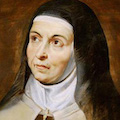
It was a very vertical law. Judging you are not worthy because you don’t have pure blood. Here comes Teresa of Avila, founding these new convents of hers. And she. Everyone was welcome. It didn’t matter what their ancestry was. Indigenous from the Americas. Welcome, former Muslims. Welcome people of Jewish blood. Welcome. And you get a lot of trouble. He said there’s a purity of blood law.
She said it doesn’t matter. All are welcome here. She took this vertical law, that was too vertical. And because she was radically horizontal. And I think that’s what today’s gospel is about, being radically horizontal. And Jesus says, try to come in through the narrow key or take the narrow road. Teresa of Avila says, “I don’t see how, Lord, nor do I know how the road that leads to you is narrow.” Because she could see that there are people in all directions who want to be part of the community, want to be united, want to love one another.
Radical horizontality. And that’s why Jesus will say, you will be surprised if you’re rejected. Because if you see the world vertically and of course, positioning yourself, then at the top of the heap superior to all of them. That’s not what Jesus is here for. He says people will come from the east, west, north and south, horizontal directions not coming from the kingdom to the mountaintops, from the summits, from the sky.
No, from the east, west, north. To the banquet. I think that’s the key. That’s why Teresa of Avila cannot see how that’s a narrow road, because that’s how she saw everything. And that’s the call for us to see everything. Not judging, not superior, them inferior, but horizontal. Brothers and sisters. All.