Only Pockets

A homily for the 25th Sunday in Ordinary Time


Got a message through Facebook. When I opened it, it said “your page is in violation of Facebook’s standards and will be deleted unless you click here”. So I clicked here and it took me to a site and log in to your Facebook page. And I realized, oh, it’s a phishing expedition. It’s a scam. But boy was it well crafted.


Beautiful logo, Facebook logo, everything. And I admired it. Even though it was nefarious. I admired it because it was so well crafted. And this is what I think is going on in today’s gospel. In this parable of the man, you’re about to be fired. So he takes, invoices to the creditors and changes the number so people are indebted to him and will take him into their houses.


And Jesus says, you got to admire the crafty manager. You got to admire him. But don’t be like him because his life is just way too narrow. There’s an Italian saying A pickpocket only sees pockets, and that’s true. But life is more than pocket. You can put together a great crafty way of finding pockets. That could be admirable, but the invitation for life is not just more pockets, more money, more something narrow.


Jesus is inviting us to life and fullness of life and love and deep relationship and a relationship with God and redemption. This is the invitation, not pockets. And that’s what I think Teresa of Avila say when she says


“There are more tears shed over answered prayers than unanswered prayers”, because oftentimes our prayers are like, I want bigger pockets, more pockets. I want more money. I want more attention. I want more tiny stuff that I think will make me happy. And it doesn’t. And Jesus wants us to be praying for life and relationships and love and big hearts, and not to settle on pockets.


So when our prayer is pocket, yeah, we’re going to cry over it when we realize how narrow that is. Today’s gospel is don’t settle on narrow. Don’t settle on small. Don’t settle on beauty. Don’t settle on pockets. Because you’ve been invited to the immensity.


Move there.

Saint Teresa of Avila

When You Can’t Let it Go

A homily for the 19th Sunday in Ordinary Time


Father Roy tells the story that when he was a new priest. So this is a few years ago, because Father Roy has been 60 years a priest. When he was a new priest, an older priest then in the house was dying. So they were taking turns through the night so the priest wouldn’t die alone. And it was Father Roy’s turn.


So he’s in the easy chair, and he falls asleep. And he wakes up because the guy is calling out to him. And. But the guy is, you know, asks for something, but Roy can’t understand. So he leans. What do you want, father? Another blanket? No, no, no. I fluff up your pillow. No no no. Something to eat?. No, no no.


No water? No. And then the priest, reaches, behind him. Points behind his. Under his pillow. So, Roy reaches under there and there’s a checkbook, and he hands the checkbook to this priest. And the priest takes the checkbook and is holding it like this, and he’s holding the checkbook and dies with it in his hand. And, I’m thinking that’s a terrible story.


But in many ways, we’re all that priest. There’s something that isn’t what we should be holding on to, that we hold on to old grudges or old vanities, or old memories or old hurts or things that that the Lord is constantly saying, let go, let those go, and we don’t want to. We’re going to clutch on to them. It could be our accomplishments, our degrees, our family, all sorts of things that we think are us, and we’re going to hold on to it.


Saint Teresa of Avila says, “Lord, I do not think I can give you everything that you ask.” Even the great Saint Teresa can’t give up everything. She has her checkbook, so she has a checkbook. You have a checkbook. But she is a great saint, she continues the prayer, “but I will allow you to take it.” That is sanctity. That we can’t give up everything. There’s something that’s just too dear to us could be for the positive or the negative. But ask the Lord to take it. In today’s gospel, Jesus says, where your treasure is, there your heart will be. I think that’s the call. Give the Lord all of your treasures. Give the Lord all your words, whatever it is that keeps you from fullness of life and living, and the fullness of this gift, and give that to the Lord. And then the Lord will have your heart. Lord, I do not think I can give you everything that you ask, but I will allow you to take it. Tough prayer, but I think we can do it.

Saint Teresa of Avila

Martha and Mary Must Combine

A homily for the 16th Sunday of Ordinary Time


Last Thursday, we celebrated a memorial. The Carmelite Martyrs of Compiegne. Compiegne is a cloister in northern France, and during the French Revolution, they were ordered to disband. And they did. They came to Paris, but they formed a community in Paris, and they were found out still living religious life. So they were arrested and ordered executed. And if executions back then were like a big social events where people selling food and jugglers and all sorts of things, people loved executions.


And in come the martyrs. These nuns. And the crowd got silent. What’s going on? Are we executing nuns now? And it’s just was dramatic. They started to sing the song. And as each one was guillotined, there was one less voice until finally the Mother Superior was guillotined and she was killed mid-line. The crowd went home in silence.


And that was the end of the Reign of Terror after the French Revolution. People said, have we come to this? What are we doing? We’re killing nuns now? And they just thought the whole thing out. And I think that’s what we have to do. That’s always the call, is to think our actions out. And is this is really what we want to be doing? To give it deep thought, deep prayer.


In today’s gospel, we have Martha and Mary. Traditionally, they’ve been, seen as Martha is the active one. She’s the one doing ministry. She’s serving Jesus food, and Mary is the contemplative one. She’s sitting at his feet and they’re kind of, Mary is a little upset. And so Jesus says, oh, Mary’s chosen the better part. And oftentimes that’s traditionally said the contemplative life is superior to the active life.


But Teresa of Avila says, no, that actually it’s both. Both have to be operative because we do so much on autopilot or so much without thought. We have to bring our actions into contemplation and contemplation. Then into action. It’s this dynamic going back and forth. And so she looks at this story of Martha, and Mary and says, “To give our Lord perfect hospitality, Martha and Mary must combine.” I think that’s what was happening with that crowd when they said, what are we doing? They thought it out, they prayed it out and they changed. I think that’s the call of today’s gospel. We have to be both contemplative and active. Not one, not the other. Both to give the Lord perfect hospitality, but to give ourselves a good and rich and wonderful life, to give our Lord a perfect hospitality, Martha and Mary must combine.

Saint Teresa of Avila

Journeying from Here to There

A homily for Corpus Christi Sunday

Today we are celebrating Corpus Christi. Corpus Christi means the body of Christ. Oftentimes, the feast is called the Body and blood of Christ. We celebrate the Eucharist today. And oftentimes when I hear the words Corpus Christi, I think of Corpus Christi procession. It’s the day for processions where after mass. Oftentimes the Eucharist is put into a monstrance, and the monstrance is walked around inside the church or outside the church, or through the neighborhood or through the parking lot.

It’s a day of processions, and I think that’s a great thing. It’s the first thing that comes to mind, and it’s a great thing because oftentimes we want to make the Eucharist like something static out there, separate to be awed and to be, worshipped out there. And no, it’s meant to be dynamic and changing. And so to have a procession is exactly what the Eucharist is about, from going from one place to another place.

And even when we receive, at mass. We always start in the pew and we head towards the altar. We don’t head towards the back or towards the side, or the Eucharist doesn’t come to us. We walk to the altar representing our journey to fullness or our journey to heaven.

Saint Edith Stein, also called Saint Teresa Benedict of the Cross, was a critic of Naziism and the political conditions of Europe. She was a Jewish convert to Catholicism, became a Carmelite nun. And so she was rounded up and sent to Auschwitz eventually to die there. And she’s a martyr, considered a martyr in the church today. Here’s what she has to say about the Eucharist. Living in the Eucharistic way means coming out of one cell, out of the narrowness of one’s life, and growing into the immensity of life in Christ. That’s why I like this image of procession, of coming out of the narrowness of one’s life and growing into the immensity of life in Christ.

I don’t think we should be celebrating processions, that kind of procession only today. This feast of Corpus Christi. But every day, to grow more and more out of my narrowness and into the immensity of Christ.

Saint Teresa of Avila

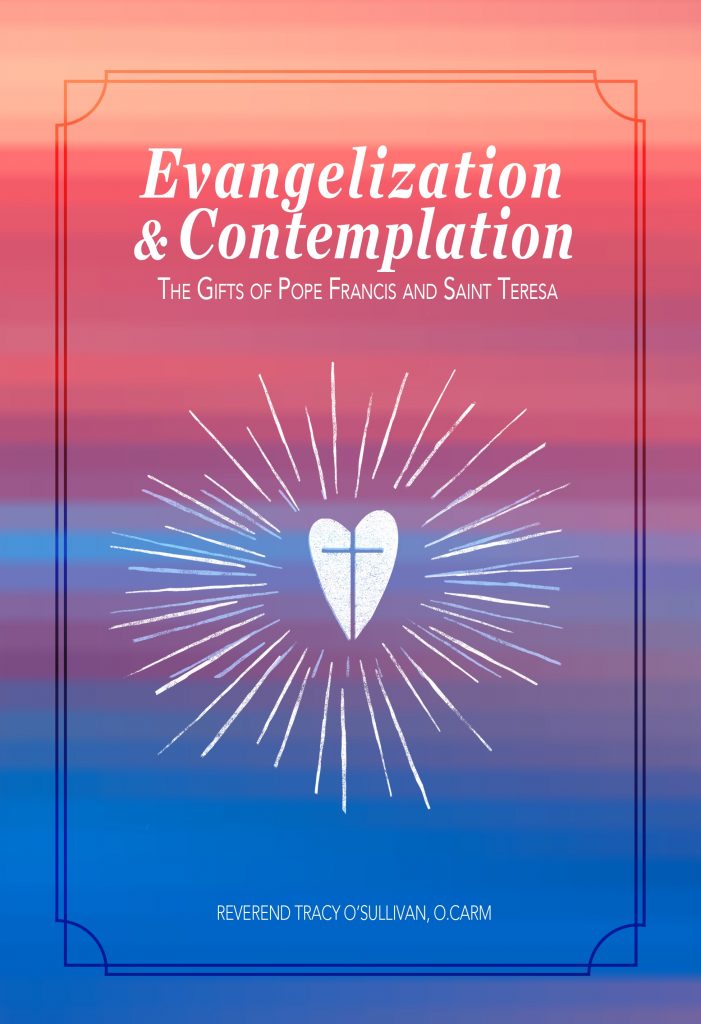
Book Review: Evangelization and Contemplation: the Gifts of Pope Francis and Saint Teresa

Evangelization and Contemplation: the Gifts of Pope Francis and Saint Teresa by Rev. Tracy O’Sullivan, O.Carm. | Dorrance Publishing Co., 2019

Seeing a world in desperate need for evangelization, especially in his work as a long-time inner city pastor, Father Tracy begins with the call for a new evangelization seen in Pope Francis’ 2013 encyclical, Evangelii gaudium (the Joy of the Gospel) and similar-themed documents from Pope Paul VI (Evangelii nuntiandi) and Pope John Paul II (Redemptoris missio).   All these documents call the Church to not only proclaim the Good News (old evangelization) but through the Gospel to transform the world (new evangelization).  But how do we get there?  Father Tracy says that the answer is prayer.

Using Saint Teresa of Avila’s book on prayer, The Interior Castle, Tracy sees that the journey of personal interior transformation proceeds from simple prayer (Interior Mansions 1 thru 3) to contemplation (Interior Mansions 4 thru 7) which leads us to more God-centered and less ego-centered ministry.  Our ego-driven needs can easily thwart the lofty call for world transformation (new evangelization) and so these documents are, in fact, a call to contemplation.  Teresa herself says, “This is the reason for prayer, my daughters, the purpose of this spiritual marriage: the birth always of good works, good works” (Interior Castle, 7.4.6).  This contemplative-based ministry is the transformative evangelization that Pope Francis (and his predecessors) calls us to in the new evangelization.  Let me try to schematize this: 

Then using the writings of Thomas Merton (Trappist spiritual writer) and Rowan Williams (Anglican Archbishop of Canterbury, emeritus) Tracy illustrates how contemplative evangelization (new evangelization) is lived and proclaimed.  Archbishop Williams, in a Vatican address, says, 
Evangelization, old and new, must be rooted in a profound confidence that we have a distinctive human destiny to show and share with the world…The humanity of Christ’s redeeming work is a contemplative humanity.”  

This call of Rowan Williams is the call of Father Tracy in Evangelization and Contemplation, and by artfully using Saint Teresa of Avila Tracy adds a Carmelite roadmap.  I think the subtitle of Father Tracy’s book should be amended to read the Gifts of Pope Francis and Saint Teresa and Father Tracy.  

Tracy O’Sullivan, O.Carm.

Available on Amazon: https://www.amazon.com/Evangelization-Contemplation-Gifts-Francis-Teresa/dp/1645302636/

The Feast of Saint Teresa of Avila

Carmelite homily for Lectionary 657 – Tuesday, October 15, 2019

Today we celebrate a great one!   This is the Feast of Saint Teresa of Avila.  My favorite quotation of hers comes from one of her letters.  She writes (it’s a prayer), “Lord, I do not think I can give you everything that you ask of me; but I will allow you to take it, and I pray that I do not try and prevent you.”  It’s a great prayer because it’s so real; it’s so human.  We think we can give everything to God, but, ahhhh.  Things that are too close to our ego, to our reputation, to our appetites; ahh, maybe not those Lord.  She’s being really human here.  But then she’s a great saint because she says, “but I will allow you to take it.”  I don’t think we have to give that stuff up – the Lord will take it from us.  And then she’s back to human and real when she says, “and I pray that I do not try and prevent you.”  

In today’s Gospel we have the vine and the branches and Jesus says that he will prune those branches.  What a great Gospel for this Feast of Saint Teresa of Avila! 

“God!” and the Devil Flees

Carmelite homily for Lectionary 465 – Friday, October 11, 2019

Today’s Gospel is about the devil and they’re accusing Jesus of being the devil.  Teresa of Avila has a great line.  She says, “Why are people so afraid of the devil; all you have to do is say the word ‘God’ and the devil flees.”  It’s as simple as that. 

Our Father

Carmelite homily for Lectionary 463 – Wednesday, October 9, 2019

Today the Gospel passage is the “Our Father.”  Saint Teresa of Avila notes that there are seven petitions – you know, like “thy kingdom come” or “give us our bread” or “help us to forgive” – seven petitions to the Our Father.  And she says, it is better to pray one petition mindfully than to pray the Our Father mindlessly.  This comes from The Way of Perfection.  So today, pray one petition of the Our Father instead of the whole Our Father. 

Martha and Mary

Carmelite homily for Lectionary 462 – Tuesday, October 8, 2019

In today’s Gospel we have the story of Martha and Mary.  The time-honored interpretation is that Martha represents the ‘active life’ and Mary represents the ‘contemplative life.’  Blessed Titus Brandsma says “The lives of the Carmelite saints are evidence that the active and contemplative life can be combined and lead to holiness.”  Saint Teresa of Avila says it so much more simply; she says, “Martha and Mary must combine.”