Carmelite homily for Thursday, March 5, 2020 – Lectionary 227 (Matthew 7:7-12)
We all know that Saint Teresa of Avila received great gifts in this life. Despite opposition, the reformation of the Order, foundation of many convents, a great spiritual life which sums up, she says, in Mystical Marriage. And the nuns reported that she would levitate in the chapel. Great gifts! Here’s what she writes, “I say only that prayer is the door to favors as great as the Lord granted me. If this door is closed I don’t see how he will grant them.” In today’s Gospel we have Jesus say, ‘ask, seek, knock and it will be given to you.’ What ties it all together but prayer? This is the invitation of today’s Gospel – to pray. The ask, the seek, the knock will be given to you. And if Teresa of Avila is right, the great favors given to her will be given to you.
Carmelite homily for Wednesday, March 4, 2020 – Lectionary 226 (Luke 11:29-32)
Because today’s Gospel passage is the same, this homily is repeated from Monday, October 14th.
Instead of giving you a Carmelite quotation today, I’m going to give you my take on today’s Gospel passage. The people come to Jesus asking for a sign and he says, “no, because you’re looking for the sign of Jonah like in the time of Nineveh, or the time of Solomon when the Queen of Sheba visited. You don’t see what’s in front of you.” I think what they’re doing is they’re living in the past. Jonah was a great preacher and the people of Nineveh turned their lives around. Solomon was a great king and the Queen of Sheba and others came from great distances to listen to him. They’re living in the past. “We were great then with Jonah; we were great then with Solomon!” But they are great today with Jesus and they don’t see it. The call of today’s Gospel is to see the goodness and the greatness right in front of us.
Carmelite homily for Tuesday, March 3, 2020 – Lectionary 225 (Matthew 6:7-15)
Because today’s Gospel passage is the same, this homily is repeated from Wednesday, October 9th.
Today the Gospel passage is the “Our Father.” Saint Teresa of Avila notes that there are seven petitions – you know, like “thy kingdom come” or “give us our bread” or “help us to forgive” – seven petitions to the Our Father. And she says, it is better to pray one petition mindfully than to pray the Our Father mindlessly. This comes from The Way of Perfection. So today, pray one petition of the Our Father instead of the whole Our Father.
Carmelite homily for Monday, March 2, 2020 – Lectionary 224 (Matthew 25:31-46)
Saint Therese reports in her autobiography, Story of a Soul, that there was a nun in the convent that no one got along with, including Therese. But Therese said, ‘she is a beloved child of God.’ So she said to herself, “I am resolved to do for this sister what I would do for the person I love the most.” I think that’s the call of today’s Gospel. We have the separation of the sheep and the goats where if someone is hungry or thirsty or naked or sick or in prison, we do something. But what about other things? Like lonely or ostracized or hurting or bullied? I think this is the call, that whatever we see right in front of us, do that. And that’s the action of a beloved sheep.
Carmelite homily for Sunday, March 1, 2020 – First Sunday of Lent – Lectionary 22 (Matthew 4:1-11)
For this First Sunday of Lent we have Jesus in the desert driven by the spirit and the devil comes to tempt him. And each temptation is heavier than the previous one. It starts off pretty small with ‘You’re hungry? Change these stones to bread.’ Not much of a sin actually. Then the next one, ‘throw yourself from the temple, angels will catch you, and everyone can ooo and ahhh.’ It’s probably a sin of pride. And the last one, ‘worship me, the devil, and I will give you control of the world.’ That’s a pretty heavy-duty sin. I think these sins are given to us in this graded sense to show how we can resist temptation – start small and work yourself big. Here’s what Saint John of the Cross has to say, “Through the practice of one virtue, all the virtues grow; through the indulgence of one vice, all the vices and their effects grow.” I think that’s what we see in this Gospel and that’s what this Lent can be about. Oftentimes we think, ahh, if I give up chocolate or give up coffee what good is that? That is a tremendous thing! It can change the world!
Carmelite homily for Saturday, February 29, 2020 – Lectionary 222 (Luke 5:27-32)
Because today’s Gospel passage is the same, this homily is repeated from Saturday, January 18th.
In today’s Gospel we have the call of Levi (or Matthew). Jesus is walking by the tax-collecting post and sees him and says, “Come follow me.” And Levi does. And invites everybody over to his house for a banquet in honor of this, and in honor of Jesus. And what is the reaction of the crowds, especially the scribes? They complain. How this man is a sinner; he’s a tax-collector. The people around here are sinners. This is a great blessing and all they see are the problems. John of the Cross says, “It is great wisdom to know how to be silent; look at neither the remarks nor the deeds nor the lives of others.” That is very difficult advice, very needed advice. That day at the customs-station, the tax-collectors station, and today. But I think John is right: it is great wisdom to be silent.
Carmelite homily for Friday, February 28, 2020 – Lectionary 221 (Matthew 9:14-15)
Saint Therese of Lisieux has the line, “It is better to love Jesus on his terms.” In today’s Gospel we have the disciples of John the Baptist saying they’re fasting and the Pharisees are fasting. Why aren’t your disciples fasting? I think we oftentimes still do that to Jesus. We want to impose our expectations, our demands on Jesus. I think Therese is right, it is better to love Jesus on his terms.
Carmelite homily for Thursday, February 27, 2020 – Lectionary 220 (Luke 9:22-25)
Because today’s Gospel passage is the same, this homily is repeated from Wednesday, November 15th.
In today’s Gospel, Jesus says whoever does not take up his cross and follow him is not worthy to be his disciple. But Jesus doesn’t say why. Why should we take up this cross? But Teresa of Avila answers it. She says, “If you wish to gain freedom of spirit begin by not being afraid of the cross.” Because it is the crosses of our lives that pull us past ego, past fear, past self-appetites, past selfishness – and self. It is the cross that brings us to freedom. So if you wish to gain freedom, begin by not being afraid of the cross.
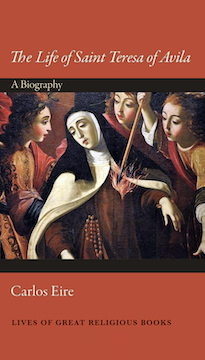
The Life of Saint Teresa of Avilaby Carlos Eire | Princeton University Press, 2019
This book, The Life of Saint Teresa of Avila, should be renamed The Life of the Life of Saint Teresa of Avila. Why? Because the book is a more about Saint Teresa’s autobiography, The Book of Her Life (oftentimes shortened to Vida in Spanish and Life in English), than it is about Saint Teresa herself. Carlos Eire is a history professor at Yale University and presents to us an extremely interesting history of, yes, Saint Teresa of Avila, but after her death (1582) the continued ‘life’ of her Life.
Professor Eire claims that The Book of Her Life really is Teresa’s magnum opus and that her other books (i.e., The Foundations, The Interior Castle, Soliloquies) are afterwords to her main work. He provides a solid interpretation of Teresa’s Life from a 21st-century perspective. He does not dismiss her extraordinary visions, locutions, or levitations but puts them as sidebars to the main point of Teresa’s book: an outline of the mystical journey to union with God. The extraordinary stuff all made sense from a 16th-century mindset, but from the 1700s (the Enlightenment) through today the extraordinary stuff comes across more as psychological disturbances than as actual events. But the main point – the mystical journey – has a timeless validity. Professor Eire does not go into all the political entanglements Teresa faced; instead, he concentrates on the entanglements that her Life caused with the Inquisition, her confessors, the Spanish aristocracy, and anyone who read her Life. Overall, in the first part of his book Professor Eire gives us a clear and easily-read biography of Saint Teresa. If nothing else, I recommend Eire’s book for this clarity.
BUT this book gets really interesting after the death of Teresa in 1582, and a lot of the history Professor Eire writes about will be new to even the ardent disciples of Teresa. Here are just a few of the things I learned:
After her death the Dominicans launched a major campaign with the Inquisition to discredit her and block her beatification and the publication of any of her works, but King Philip IV and the royal family silenced any opposition.
After her canonization, Philip IV declared her to be the co-patron of Spain (along with Saint James; i.e., Santiago) but the Pope squelched that.
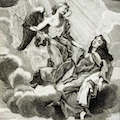
Various picture-books (remember this was an illiterate age) of Teresa’s Life were published after her death. One of the engravings from a popular picture-book by Arnold van Westerhout became the template that Bernini used in his famous statue, The Ecstasy of Saint Teresa.
Sigmund Freud and his disciple, Jacques Lacan, pronounced her the patron saint of hysterics.
When given a reliquary containing Teresa’s left hand Generalissimo Francisco Franco pronounced her the patron saint of fascism (and the Superior General of the Discalced Carmelites wrote a treatise supporting this!). Franco even published a magazine for fascist women called Teresa (1936-1975).
Virgil Thomson wrote an opera, with the libretto by Gertrude Stein, called Four Saints in Three Actsabout Saint Teresa and Saint Ignatius of Loyola
Do I recommend this book? You bet! Whether you’re new to Saint Teresa and her works (especially her Life) or you’ve been a life-long disciple, you will learn a lot.
Arnold van Westerhout’s ‘The Ecstasy of Saint Teresa’
Carmelite homily for Ash Wednesday, February 26, 2020 – Lectionary 219 (Matthew 6:1-6,16-18)
Humility doesn’t mean being smarmy and allow people to walk all over you or to treat you like a doormat. No! Humility means not being controlled by your ego. That’s what we see in today’s Gospel. When you pray, don’t pray in front of everybody so everyone says, ‘look how holy she is.’ Or when you give gifts or donations don’t blow a trumpet or call attention to it so everyone says, ‘look how, how generous he is.’ Or when you’re fasting don’t look all beaten up so everyone can say, ‘look how god-focused she is.’ No, that’s all ego. The idea is to not let ego control this, but to let love control this, God control this, the other control this, your heart control this. This is the call for Ash Wednesday. Saint Teresa of Avila writes, “If there is no progress in humility, everything is going to be doomed.” Let’s make that the focus for this Lent – progress in humility. Which means simply, don’t be controlled by your ego, be controlled by love.